About Rubber Insertion Jointing for air
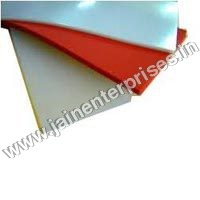
Rubber Insertion Jointing for air & water pressure:-
Application: Used between flanges and similar joints subjected to water, steam & air pressure.
Composition: Natural/synthetic/blend rubber is used in manufacturing of sheet rubber jointing and rubber insertion jointing free from surface defects, porosity and grit.
Fabric Reinforcement: The reinforcement fabric used for rubber insertion jointing having minimum breaking load of 120N/cm (approx. 12kgf/cm.) for both warp and weft direction.
| Thickness
in (mm) | Tolerance on
Thickness (mm) | No. of Plies |
| 0.8 | ± 0.2 | 1 |
| 1.5 | ± 0.2 | 1 |
| 3.0 | ± 0.3 | 2 |
| 5.0 | ± 0.5 | 2 |
| 6.0 | ± 0.6 | 3 |
| 8.0 | ± 0.7 | 4 |
Engineered for Reliable SealingThe rubber insertion jointing sheets are meticulously designed for exceptional sealing efficiency in air, water, and low-pressure steam systems. Their polyester fabric reinforcement ensures dimensional stability while maintaining flexibility, contributing to both strength and adaptability in demanding environments.
Versatile Applications Across IndustriesWith its robust construction and temperature resistance, this jointing solution supports industrial sectors such as HVAC, plumbing, and machinery maintenance. Its moisture-proof and abrasion-resistant properties enhance longevity, making it suitable for both indoor and outdoor settings.
Customizable to Project RequirementsAvailable in various thicknesses (0.5 mm to 12 mm), widths (up to 2 meters), and roll lengths, this insertion rubber sheet can be tailored to project specifications. Edge options include trimmed or straight cut, and customers can choose between smooth or cloth finishes for optimal compatibility.
FAQs of Rubber Insertion Jointing for air :
Q: What is Rubber Insertion Jointing and how is it used for air sealing?
A: Rubber Insertion Jointing is a sealing sheet made from a natural rubber blend, reinforced with polyester fabric to provide added strength and durability. It is used for sealing joints in air lines, air ducts, and related systems to prevent leakage and ensure efficient airflow. Its specific composition makes it ideal for air, water, and low-pressure steam applications.
Q: How does the reinforcement with polyester fabric benefit the jointing sheet?
A: Polyester fabric reinforcement enhances the mechanical properties of the rubber, such as tensile strength and dimensional stability, without compromising flexibility. This ensures the sheet maintains its shape and performance under pressure and temperature fluctuations, providing dependable long-term sealing.
Q: When should I use this type of Rubber Insertion Jointing?
A: This insertion rubber sheet is recommended for applications requiring reliable air, water, or low-pressure steam sealing at temperatures between -20C and +80C. It is particularly suitable for industrial piping, HVAC systems, and mechanical joints where strong, flexible sealing is essential.
Q: Where can these rubber sheets be installed?
A: The sheets can be installed in a variety of settings such as industrial manufacturing facilities, workshops, and utility plants. They are well-suited for sealing pipelines, air ducts, and machinery that require air-tight or moisture-proof barriers.
Q: What is the process of manufacturing Rubber Insertion Jointing for air?
A: Manufacturing involves blending natural rubber with fillers and processing aids to achieve desired hardness and performance. Polyester fabric is inserted between layers of rubber during calendaring, creating a reinforced composite sheet, which is then vulcanized, finished (cloth or smooth), cut to size, and packaged.
Q: What are the key benefits of using this product?
A: Key advantages include high tensile strength, excellent elongation (up to 250%), resistance to moderate abrasion and moisture, and temperature tolerance from -20C to +80C. These properties ensure long-lasting performance in sealing applications, reducing maintenance needs and improving operational efficiency.

 Send Inquiry


 Send Inquiry

 Send Inquiry
 English
 Spanish
 French
 German
 Italian
 Chinese (Simplified)
 Japanese
 Korean
 Arabic
 Portuguese